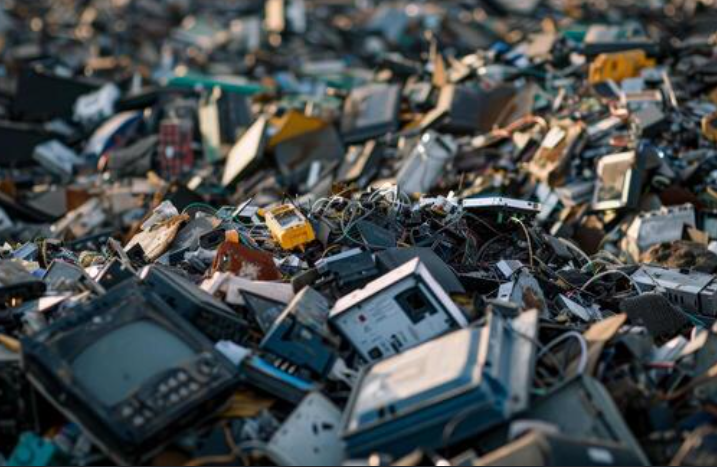
The conversation about discarded technology usually starts with contamination: what leaches out of a landfill, what happens when batteries ignite, what informal processing does to the communities that host it. All of that is real and well documented. It is also only half the picture, and arguably the less consequential half.
The other half is what does not happen when a device is buried. Every discarded phone, laptop, and server represents a quantity of refined metal that took enormous energy and environmental disruption to produce, and burying it means that quantity has to be produced again from the ground to make the replacement.
Viewed through that lens, the e-waste environmental impact is best understood as a supply chain failure rather than a waste management failure. The material is not gone. It is simply put somewhere nobody can reach it, at exactly the moment when the industries that need it are struggling to secure supply.
What a Tonne of Devices Actually Contains
The concentrations involved are striking when compared against natural ore bodies.
Circuit boards contain gold in quantities that exceed what commercial gold mines extract from an equivalent mass of rock, often by a factor of many times over. Silver and palladium are present in comparable relative abundance, used in contacts, connectors, and capacitors.
Copper is the volume metal, present in wiring, board traces, heat sinks, and motor windings. Aluminum makes up chassis and heat management components. Steel provides structural elements.
Cobalt and lithium sit in batteries, and both are on nearly every national critical minerals list. Rare earth elements including neodymium and dysprosium appear in hard drive actuators, speakers, and vibration motors, and their supply is heavily concentrated in a small number of countries.
Aggregate across the global volume of discarded electronics and the recoverable value runs into tens of billions annually, most of which is currently not recovered.
The Energy Argument Is Even Stronger Than the Material One
Recovering metal from retired equipment consumes dramatically less energy than producing it from ore, and the differences are not marginal.
Recycled aluminum requires roughly five percent of the energy needed for primary smelting. Recycled copper avoids the mining, crushing, grinding, flotation, and smelting sequence entirely, along with the acid drainage that open pit copper operations generate for decades after closure.
Gold is the most extreme case. Primary gold production moves enormous quantities of rock and relies on cyanide leaching to extract concentrations measured in grams per tonne. Recovery from circuit boards works with concentrations orders of magnitude higher, in a controlled industrial setting.
For an economy trying to reduce industrial emissions, secondary material supply is one of the few levers that reduces both energy consumption and land disturbance at the same time, without requiring any change in what gets manufactured.
Why Supply Security Changed the Politics of This
The environmental case for recovery has existed for decades without producing much action. What changed the trajectory was the recognition that critical mineral supply is a strategic vulnerability.
Cobalt, rare earths, and lithium all have highly concentrated supply chains, and concentration creates exposure to trade restrictions, political instability, and price volatility. Industries dependent on those inputs, particularly electronics, defence, and vehicle manufacturing, have become considerably more interested in domestic secondary supply.
Retired equipment is the one source of these materials that already exists inside national borders, requires no new mining permits, and faces no geopolitical exposure. That has moved recovery capacity from an environmental initiative to an industrial policy concern in several jurisdictions, with corresponding investment.
The Barriers Are Practical Rather Than Technical
Recovery technology is mature. What limits the rate of recovery is that material does not reach it.
Collection is the primary constraint. Devices sitting in drawers and storerooms are not in the recovery stream, and household collection rates remain low across most markets even where convenient options exist. The material is dispersed across millions of locations, and aggregating it is the expensive part.
Design is the secondary constraint. Adhesive assembly, soldered components, and mixed material construction make disassembly labour intensive. Repairability requirements now being introduced in several jurisdictions will improve this over time, though the effect will take a full product cycle to appear in the recovery stream.
Economics is the third. Recovering common materials from consumer devices is often marginal on its own, which is why processing tends to depend on high-value board content and on business volumes where equipment arrives in bulk and in known condition.
What Follows From This View
Framing this as resource recovery rather than waste disposal changes the practical priorities in a useful way.
It puts device longevity at the top, because keeping a machine in service defers replacement manufacturing entirely, which is the largest single environmental cost in the lifecycle.
It puts reuse second, because a functioning device passed to another user delivers the same benefit.
It puts material recovery third, valuable but a distant third behind keeping equipment working.
And it puts collection above almost everything else in terms of what individuals and organizations can actually influence, because a device that never reaches a processor cannot be recovered no matter how good the technology is. The recovery infrastructure exists and is expanding. The constraint is getting material to it, and that constraint is made up entirely of small decisions about where things go when they stop being useful.